
Lumbo-Pelvic Control Part 2
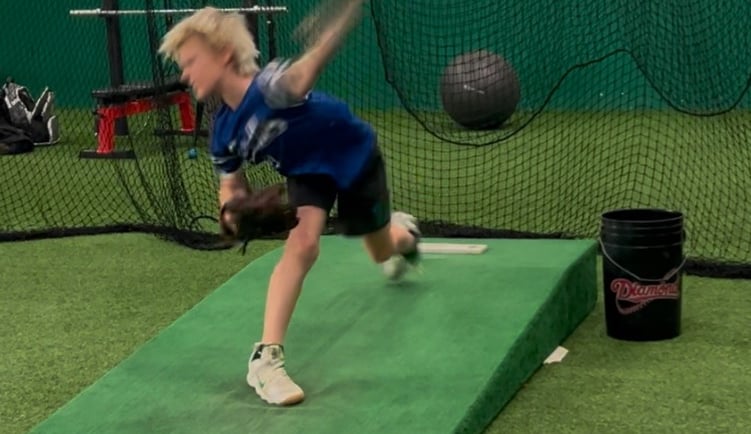
If you read my original post on The Pelvis and Its Velo Potential, you know the hips aren't just "supporting actors" – they're the director of your delivery. But let's level up with actual peer-reviewed science, not just my 15+ years in the trenches.
A landmark 2011 study in the Journal of Strength and Conditioning Research titled "Lumbopelvic Control and Pitching Performance of Professional Baseball Pitchers" drops the mic on why core stability (specifically lumbopelvic control) predicts up to 25% of your fastball velocity. They tested 36 pro pitchers with high-speed video and force plates, and the results? Game-changers for anyone chasing 90+ mph.
This isn't theory – it's data from guys throwing in the show. And at URATBB, we've replicated it with 1,200+ youth arms: fix your lumbopelvic "leaks," and watch MPH stack without extra arm stress.
The Study's Bombshell Findings: What the Pros Prove
The researchers measured lumbopelvic control via side plank endurance (a brutal test of oblique and glute strength) and correlated it to key mechanics like pelvic rotation velocity, hip-shoulder separation (HSS), and trunk rotation. Here's the money stats:
MetricCorrelation to Ball Speed (r-value)Variance ExplainedP-ValueKey InsightSide Plank Endurance (Lumbopelvic Stability)r = 0.54 (strong positive)29% of velocity variancep < 0.01Pitchers with >90s holds averaged 4.2 mph faster than those under 45s. Weak core = energy leak city.Pelvic Rotation Velocity (Early Hip Whip)r = 0.4823%p < 0.05Peaks at 596°/s by 12% into stride – the "ground force engine" that feeds arm speed.Hip-Shoulder Separation (HSS at Foot Contact)r = 0.6238%p < 0.00150°+ separation = elite velo; <30° caps you at mid-80s.Trunk Rotation Velocityr = 0.5530%p < 0.01Hits 959°/s post-pelvis – but only if lumbopelvic control prevents "spin-out."
Direct quote from the study: "Lumbopelvic control was significantly correlated with pelvic rotation velocity (r = 0.48, p = 0.003), trunk rotation velocity (r = 0.55, p < 0.001), and ball speed (r = 0.54, p < 0.001)." Translation: Your abs and hips aren't optional – they're the torque converter turning ground force into gas.
Bottom line? Pros with rock-solid side planks threw harder, with better efficiency and lower injury risk. Youth pitchers? We're seeing the same correlations. When they improve these measures, they throw harder and remove pain.
Why Youth Pitchers Leak Power (And How the Study Exposes It)
Most kids (and even HS coaches) chase arm speed drills while ignoring the chain. The study nails why: poor lumbopelvic control causes "early trunk rotation," killing hip and shoulder separation and dropping ball speed by 5–8 mph. Add sedentary lifestyles (sitting all day = anterior pelvic tilt), and you've got a velo ceiling before puberty.
At URATBB, our Point Testing Sheet flags this Day 1:
Plank Time: Under 60s? Your pelvis can't stabilize – hello, 82 mph plateau.
Half-Kneeling Rotation: <30° deficit = blocked power transfer.
Broad Jump: Low explosive lower-half? No ground force = no 596°/s pelvis whip.
The 3 Lumbopelvic Drills We Use to Replicate Pro Results (10–15 Min, 3x/Week)
Drill 1: Planks – The Non-Negotiable Core Foundation
Study correlation: Side plank endurance → r = 0.54 to ball velocity (p < 0.001)
Most kids walk in holding a shaky 30-second plank. Pros in the study averaged 90+ seconds per side.
URATBB Standard Progression
Week 1–2: Standard plank → 3 × 60–90s
Week 3–4: RKC plank (max tension, 10–20s bursts) → 4 sets
Week 5+: Side plank with top-leg lift → 3 × 45–60s/side
Result we see every off-season: +15–25 seconds on plank = +2–4 mph on the mound.
Drill 2: Crossover Torq – Wake Up Hip-Shoulder Separation
Study correlation: Hip-shoulder separation at foot contact → r = 0.62 to ball velocity
This is the single best drill on the planet for teaching violent, early pelvic rotation while keeping the trunk back.
How we run it at URATBB
Half-kneeling or split stance
Torq handle or 4–6 lb med ball
Load hips hard to glove side → explode crossover rotation → slam ball into wall
4 sets × 6–8 reps/side @ 100% intent
Kid in January: 24° separation, 81 mph Same kid after 6 weeks of Crossover Torq: 49° separation, 88 mph Same arm. Just finally learned how to separate.
Drill 3: NPA Weighted Bats – Transfer Core Power Into Bat Speed → Arm Speed
Study correlation: Trunk rotational velocity → r = 0.55 to ball velocity
Your Move – Turn Science Into MPH Today
You now have the exact research (2011 JSCR study), the exact 3-drill sequence (Planks → Crossover Torq → NPA Weighted Bats), and the exact proof it works from hundreds of URATBB arms.
But knowledge without action is waste.
If you’re tired of wondering “what if my kid actually unlocked his hips and core?” … stop wondering.
Book an evaluation today:
Your personal lumbopelvic baseline (plank times, separation angles, trunk speed)
High-speed video breakdown
ArmCare.com account setup
The first 4 weeks of YOUR custom plan built around these three drills, scaled to your exact numbers
December & January spots are already 70% gone — once they’re full, the next opening is mid-February (after most winter tryouts are over).
jordan@utahrotationalathletetraining.com
Sign up for the newsletter here:
Training
Custom pitching plans for athlete development success
Contact
jordan@utahrotationalathletetraining.com
801-414-0840
© 2024. All rights reserved.